Organizational Stability Infrastructure (ROS™)
Engineering Stability, Not Just Managing Burnout
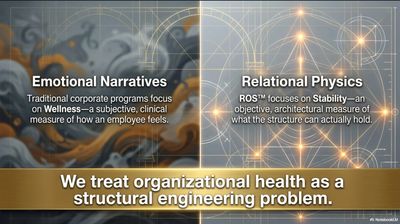
The world's first Relational Operating System, built on the physics of human structural load. Most HR tools measure how employees feel. ROS measures what their structure can actually support — and treats those as two different questions.
The Problem:
The Structural Error of Modern HR
Most wellness programs treat burnout as a personal deficit — as if the fix is asking people to be more resilient. But engagement is an output. Load is the input. Asking someone to perform better without reducing what they're carrying isn't just ineffective — it's diagnosing the wrong layer of the problem.

Upstream Diagnostic Solutions Infrastructure.
The ROSE Score shifts the conversation from "how does this employee feel" to "what is this employee's environment actually asking of them" — structural clarity instead of a sentiment survey.

Resolve™ (Employee facing app)
Resolve translates biometric and behavioral inputs into a Net Load Index (NLI): one real-time number showing how much structural load a person is carrying, and which of the five regulators is driving it. Where ROSE looks at environment alone, Resolve's NLI looks at the whole picture — because a low environmental load can still sit on top of a badly damaged relationship or an unsustainable schedule, and NLI is built to catch that.
Slider values and physiological inputs are saved locally, on the user's own device — never uploaded as raw data. The shift is from "I feel overwhelmed" to "my structural capacity is depleted": objective load, not a mood report.

Individual Employee Privacy Is Paramount
The Four Pillars of Structural Privacy
- Local Storage — physiological assessments stay under the user's own control, client-side, never leaving their device as raw data.
- The Restraint Layer — the API blocks transmission of raw biometrics to the organizational level. Individual readings never reach HR.
- Data Aggregation — dashboards only ever show de-identified, pooled Aggregate Load Distribution — never one person's number.
- Structural Diagnosis — reporting is framed as architectural, not personal. Issues surface as load, not as a moral or mental-health verdict on any individual.

Reveal™ (HR Aggregate Dashboard:)
Individual NLI scores are triage. Reveal is the pattern across a team — translating individual load into systemic organizational action.
- Organizational Load Mapping — visualizes where pressure is concentrated across departments.
- Predictive Fracture Identification — spots systemic vulnerabilities before they surface as turnover or conflict.
- Net Load Index (NLI™) — gives HR directors one quantifiable, calculable metric, driving data-driven interventions like reducing non-essential decision load in the areas that need it most.
The NLI Human State API
Real-time structural signals — decision-bandwidth and error-probability calibration — available before a high-stakes task is assigned, not after it's already gone wrong.

The Five Regulators of Relational Physics
System metrics, not personal opinion:
- Environment — external pressure and conditions
- Self — internal processing capacity
- Mortar — the behavioral compounds holding the system together: Respect, Honesty, Reliability, Trustworthiness, Boundaries, Effort
- Reciprocity — whether load is actually distributed, or concentrated on one person
- Time — how duration amplifies whatever structural condition already exists
All five holding steady over time is what produces Trust — not a sixth input, but the outcome of the other five actually working.

If Leadership is Compressed
It's felt at every level
The Value Proposition:
Fix the Structure, Not the Person
Rouse OS Enterprises builds for structure over blame, clarity over conflict, architecture over assumption. ROI of Stability